
Early GST rollout to help create more jobs, boost output, says IMF.

The economy could grow at 6-6.5 per cent this fiscal year (2019-20 or FY20), said Chief Economic Advisor Krishnamurthy Subramanian, revising his earlier estimate of 7 per cent in the Economic Survey. In an interaction with Arup Roychoudhury, he said supply-side measures, including corporation tax cuts, will boost consumption and demand, and non-tax revenue may make up for shortfall in tax revenues.

'Investors should reduce cash gradually and look for value investing.'

Businesses are still taking time to adjust in the new tax regime, which would weigh on growth rates for the financial year closing today.

The Reserve Bank remains laser-focused to bring back retail inflation to 4 per cent over a period of time in a non-disruptive manner, Governor Shaktikanta Das stressed while voting for status quo in interest rates, as per minutes of the October policy meeting released on Friday. The central bank has been mandated by the government to ensure the Consumer Price Index (CPI) based inflation is at 4 per cent, with a band of 2 per cent on either side. The retail inflation, which was above 6 per cent during May and June, has started moving down and stood at 4.35 per cent in September.

Domestic markets are also aided by a rally in the global markets with US market surging to record high and a firming trend at other Asian bourses.

The shift from 'one country, one tax' to four tax rates could dilute possible gains on GDP, warns T N Ninan.

On the other hand, 16 or half of all states and Union Territories account for only 3 per cent of all exports.

Changes in threshold not to have a significant revenue impact, say officials

The Confederation of All India Traders has approached Union Home Minister Amit Shah, Union Health Minister Harsh Vardhan, Delhi Lieutenant Governor Anil Baijal, and Chief Minister Arvind Kejriwal, and urged them to shut markets in Delhi.

The FPI holding in India's top 100 companies, which are part of the Nifty 100 index, declined to 24.23 per cent on average at the end of March this year, from a high of 27.5 per cent at the end of March 2021. This is the lowest FPI holdings in India's top listed companies in at least three years. A general sell-off by FPIs has weighed on stock prices and the benchmark S&P BSE Sensex is down 8.5 per cent, from its 52-week high made in October 2021. Most analysts expect FPI flows to remain weak in FY23 as well, given rising bond yields in the US and an expected earnings slowdown in India due to high inflation and commodity prices.

The divestment target remaining unchanged, from the 2019-20 interim Budget, this year means the Centre will now have to depend on non-tax revenue sources like dividends from the RBI, PSBs and PSUs, as there are real concerns of a tax revenue shortfall. The fiscal deficit target of 3.4% of GDP for 2019-20 is likely to be retained as well.

To address the supply crunch, CII has suggested leveraging the existing excess capacity in the Indian industry; rolling back import duty hike to look for alternative sources of imports; expanding credit to manufacturing units with quick loan sanctions, and one-time emergency waiver of non-performing asset regulations for three months.

A fundraising boom in the domestic market and tightening of the regulatory framework for overseas issues are responsible for this trend.

India is a market for low-priced cars with low running costs. The global majors don't have models that fit the bill; only Maruti and Hyundai have successful entry-level models, observes T N Ninan.

Even as the industrial cycle has ground to a halt during the 21-day lockdown, the industry has been hit hard by foreign orders from major clients in the US and Europe being cancelled. Also, a sudden lack of labour has crippled the sector because of a mass exodus of workers from industrial units to the hinterland.

The Indian rupee is down nearly 2 per cent against the US dollar since the beginning of January 2019. Experts attribute the Indian rupee's relatively poor performance to a sharper-than-expected fall in economic growth in India.

Economic performance is affected if large numbers of people are out of work, or at such low levels of income as to force under-consumption, observes T N Ninan.

Mandatory hallmarking of gold would be a positive in making the gold market more organised. Mandatory hallmarking would come into effect from January 15, 2020, with a one-year transition period for trade to sell existing inventories. Experts also expect more policy measures next year to bring in more transparency in terms of gold as an asset class.
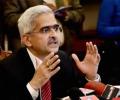
Reserve Bank Governor Shaktikanta Das has pitched for policy support from all sides -- fiscal, monetary and sectoral -- to nurture recovery of the economy hit by the second wave of the coronavirus pandemic. The dent on economic activity due to the second wave of the pandemic during April-May necessitated continuation of monetary measures to support the process of economic recovery to make it durable, Das had said while participating in the meeting of the Monetary Policy Committee (MPC) earlier in the month. "Overall, the second wave of COVID-19 has altered the near-term outlook, and policy support from all sides - fiscal, monetary and sectoral - is required to nurture recovery and expedite return to normalcy," Das said, as per the minutes of the meeting released on Friday.

The government is also working on Euroclearing, the world's biggest bond settlement system, for Indian debt securities.

'Many of the challenges of investing in commercial real estate get taken care of when an investor takes the Reit route,' points out Suraj Nangia.

Regulated electronic platforms such as e-spot markets or spot exchanges may be deemed as authorised markets.

For the week, the Sensex recorded a fall of 371 points, or 1.10 per cent, and the NSE Nifty 130.75 points, or 1.25 per cent.

'There shall be no change in India-Japan ties,' predicts Rajaram Panda.

The order in favour of Vodafone is being considered significant because some domestic companies too are involved in similar transfer pricing cases.

Losers include ONGC, Bajaj Finance, Reliance, SBI, Hero MotoCorp, ICICI Bank, L&T, Vedanta, Yes Bank and Axis Bank, falling up to 2.54 per cent. On the other hand, Tata Steel, PowerGrid, HCL Tech, Kotak Bank and Maruti were the top gainers on Sensex, rising up to 2.31 per cent.

Finance firms in these SEZs likely to get tax breaks.

The power of the small neighbourhood retailer can barely be ignored as organised players look to leverage their last-mile connectivity and reach, luring them by promising support in technology, inventory and tax management.

Capital markets regulator, I-T department suspect tax evasion and market manipulation

Market experts on why the bulls will be on the rampage first thing on Monday after the scrapping of enhanced surcharge on FPIs and other measures to ease the systemic liquidity squeeze and boost demand. Prasanna D Zore reports.

Tech companies typically do lots of business overseas and book profits in low-tax jurisdictions.

The department of economic affairs, in its Monthly Economic Review for September, said critical reforms undertaken by the government will put India to a strong and sustainable growth path in the long run.

Overseas funds have been spooked by several policy measures taken by the government in the past few years

'It is entering growth territory on a month-on-month basis.'

The Bangladeshi prime minister said that India's sudden decision to stop onion exports has led to a bit of difficulty for her countrymen.

A smartly executed reform-recap will be the best booster for the economy, says Ajay Chhibber.

The need of the hour is to support e-commerce companies through benign policies and not to treat them as mere cash cows.

India's jugalbandhi with coal and clean energy is coming unstuck, neither achieving adequate renewable generation nor ensuring sufficient coal-fired power in the quest to become a $5-trillion economy. Six months have elapsed since Prime Minister Narendra Modi announced an ambitious climate agenda for India at COP26 at Glasgow. The net zero emissions target by 2070 is a distant one, but there are nearer-term plans to meet 50 per cent of energy demand with renewables by 2030 by increasing capacity to 450 Gw. A cursory look at the balance sheet of India's climate progress since November reveals ponderous progress towards meeting the renewables target even as the country is scrambling to expand coal-fired generation in the face of a power crisis.

The substantially increased economic dualism may exert lasting negative influences which could include a reduced potential for economic growth; the persistence of a very weak employment and poverty situation; rising social and political discord; and heightened vulnerability to geopolitical challenges, cautions Shankar Acharya, former chief economic adviser to the Government of India.
